
Borrowed medical authority
borrowed-medical-authority
Define
The claim wears a lab coat: a diagram, a percentage, a clinical tone that is not necessarily a clinician.
Mechanism
Authority costume. Science-looking form transfers trust. Use it only when the substance matches, or we are documenting a historical mechanism. We do not recommend the abuse.
Verdict
We have real evidence and the buyer needs it in a form they already trust: a chart, a protocol, a named standard.
Don't
We are faking a study. This library records the mechanism. It does not license junk science.
Copy skeleton
[SYMPTOMS: the signs the reader already recognises in themselves]
[CAUSE: one plain explanation of why it happens]
[HOW IT WORKS: the active ingredient or method, in clinical terms you can back]
[CREDENTIAL: registration number, named standard or a study you can cite]
[VOICE: a named expert or peer who has the right to say it]
[HOW TO USE: dose or routine] · [WHERE TO BUY]
[RISK REMOVED: what happens if it does not work]
Gulf note
In Saudi Arabia, health and nutrition claims on food, supplements and cosmetics answer to the SFDA, so the only lab coat worth wearing is the claim the product's registration already supports. Show the registration number and the named standard rather than a stock doctor: a real practitioner who endorses a product has professional rules to check first, and paid social creators need a Mawthooq licence. Put the clinical lines in plain fusha and let the peer voice speak Saudi dialect. Never promise a cure, and never use a doctor's face you did not hire.
Rights-cleared examples

"Treating by Mail" mail-order medical newspaper
The whole page is a costume: masthead, volume number, column rules and deck headlines make paid advertising look like a subscribed newspaper, which buys attention and credibility that a circular could not.

'How to Eat for Health' ad, Red Book, 1916 (page 2 of 2, with coupon)
The page closes as an article, not a pitch: the writer speaks as an outside observer who is "authorized to say" no money need be enclosed, so the five days' free examination and the $3 fee read as a favor passed on.

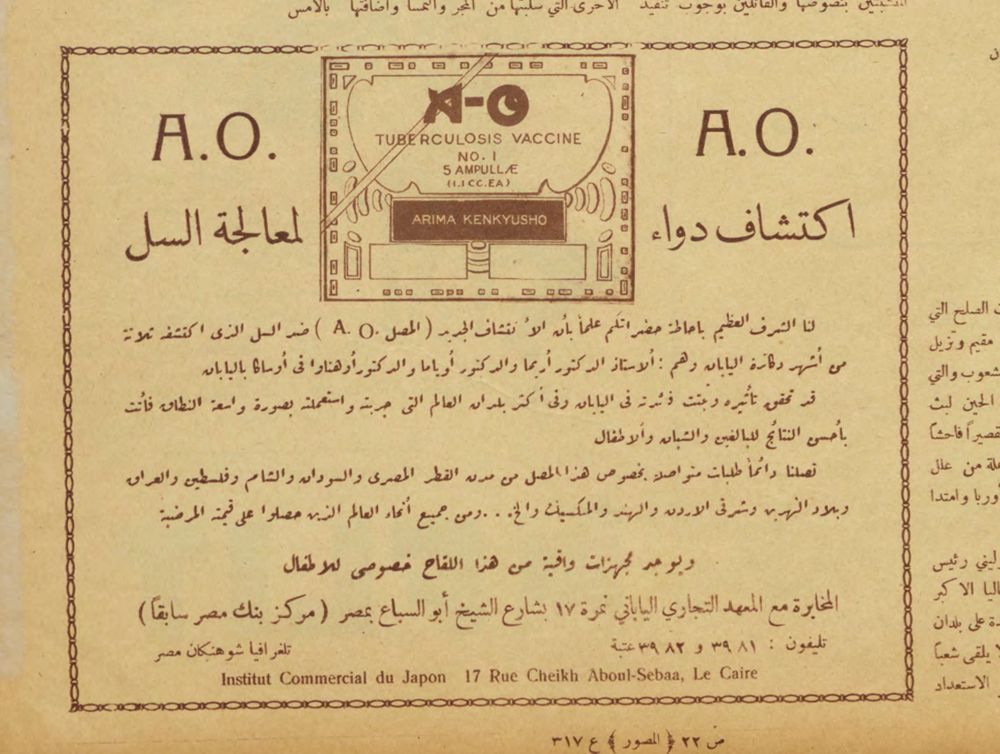
A.O. tuberculosis serum ad, al-Musawwar 1929
The headline is written as news of a discovery, not a sales line, about a disease readers feared as a death sentence.
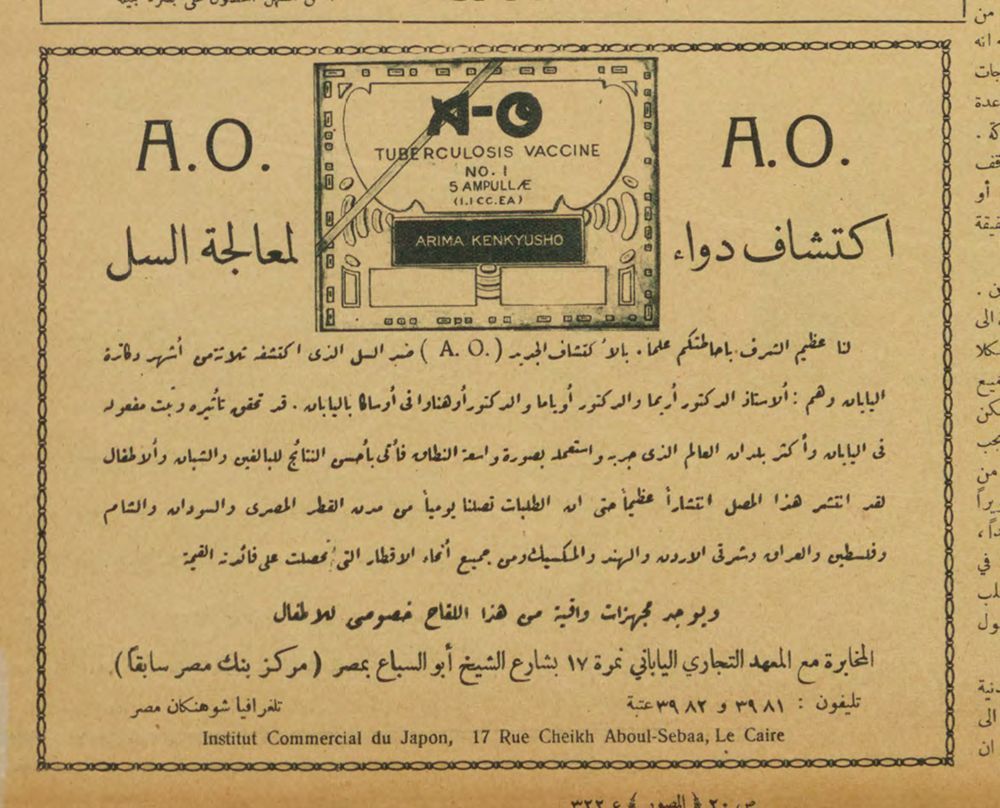
A.O. tuberculosis vaccine ad, al-Musawwar 1930
Tuberculosis was the most feared disease of the day, and the ad answers that fear with the look of a laboratory: a drawn box of numbered ampoules, a Latin label, and named professors from Japan.
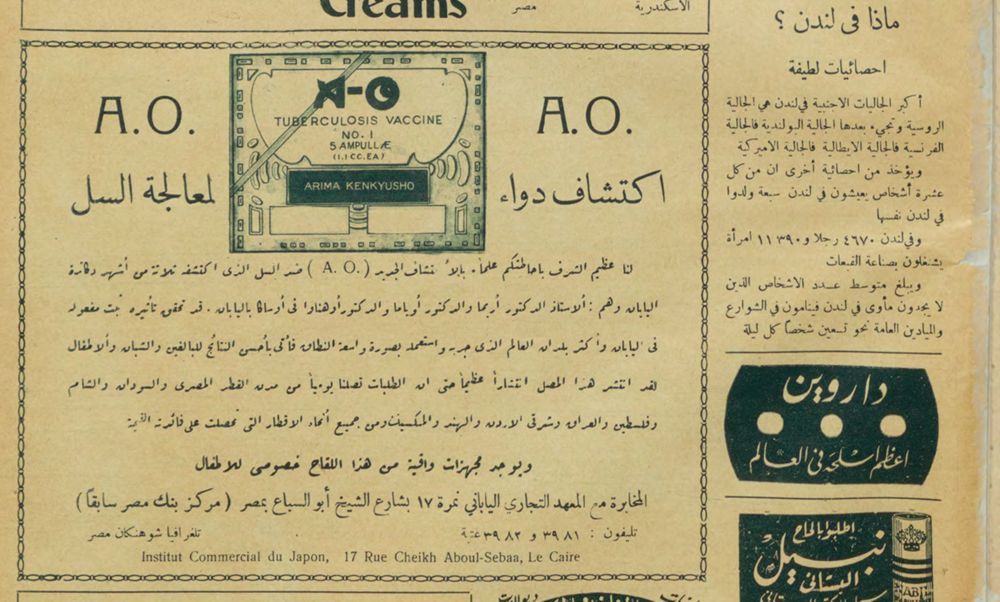
A.O. tuberculosis vaccine ad, al-Musawwar 1930
The ad is framed as news, the discovery of a medicine, and it names the Japanese professors credited with it, so authority comes from titled scientists rather than from the seller.
A.O. tuberculosis vaccine ad, al-Musawwar 1931
The word 'discovery' next to the most feared disease of the day stops the reader, and the drawn vaccine box with its printed English label makes the cure look real and packaged.
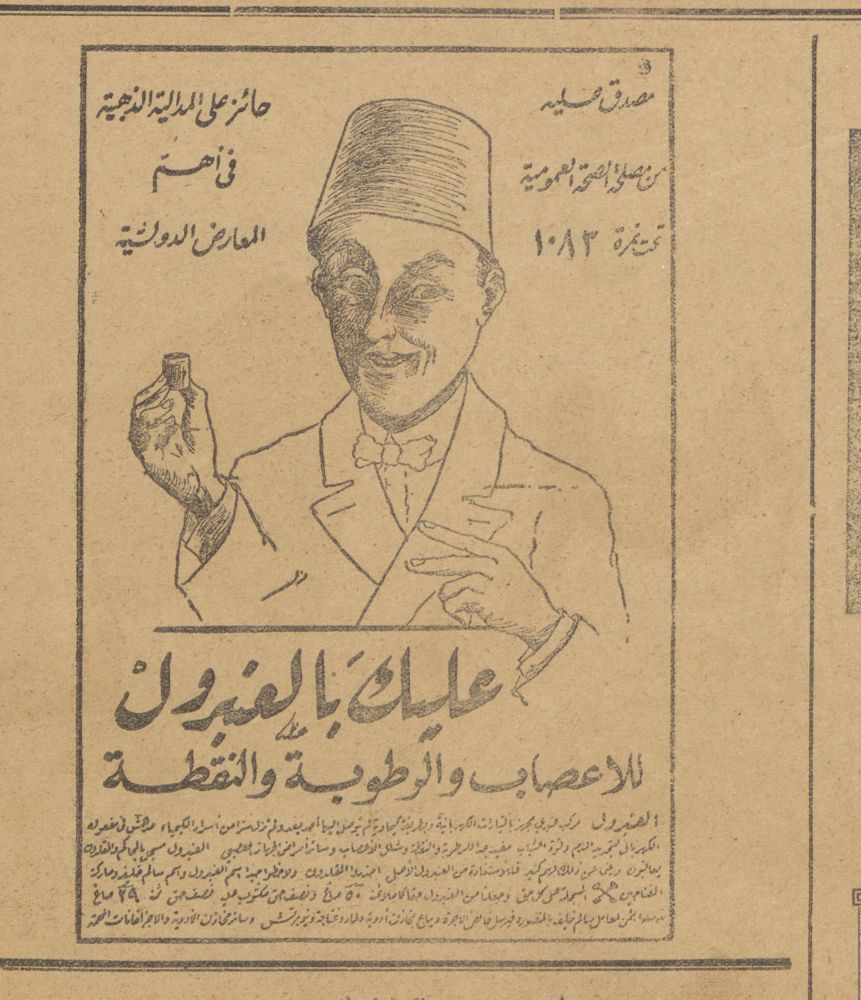
al-Anbarol nerve tonic ad, al-Kashkul 1928
The headline is an order, 'you must take al-Anbarol', spoken by a cheerful man in a fez who raises the vial toward the reader like a friend's tip.

al-Anbarol tonic ad, al-Kashkul 1925
The column dresses a tonic in the language of science: it acts like an electric current in the veins, it came out of a laboratory's long research, and a council of doctors added gland extracts linked to a famous physician's name.
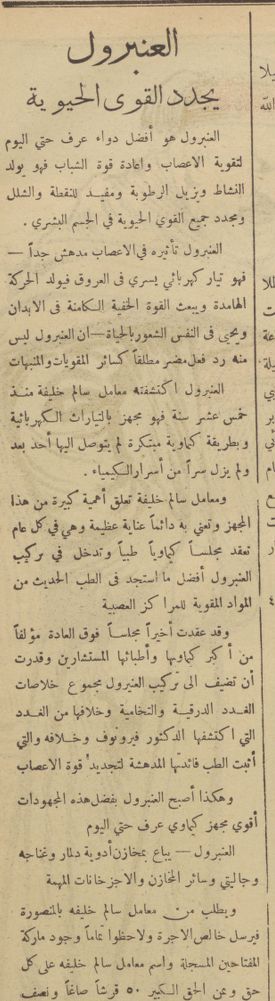
al-Anbarol tonic ad, al-Kashkul 1925
The long column piles up scientific-sounding proof, an electric current in the veins, years of laboratory work, a council of doctors, then turns the reader into an inspector: check that every box carries the registered two-keys mark and the laboratory's name.
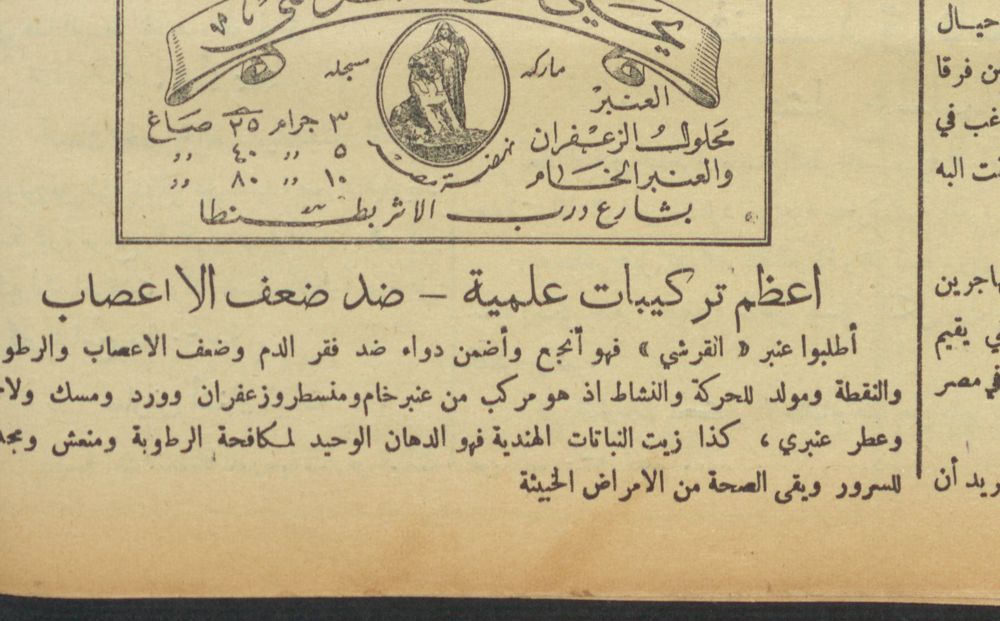
al-Farshi amber tonic ad, al-Kashkul 1926
The headline dresses a traditional remedy in modern language: the greatest scientific compounds, against weak nerves.
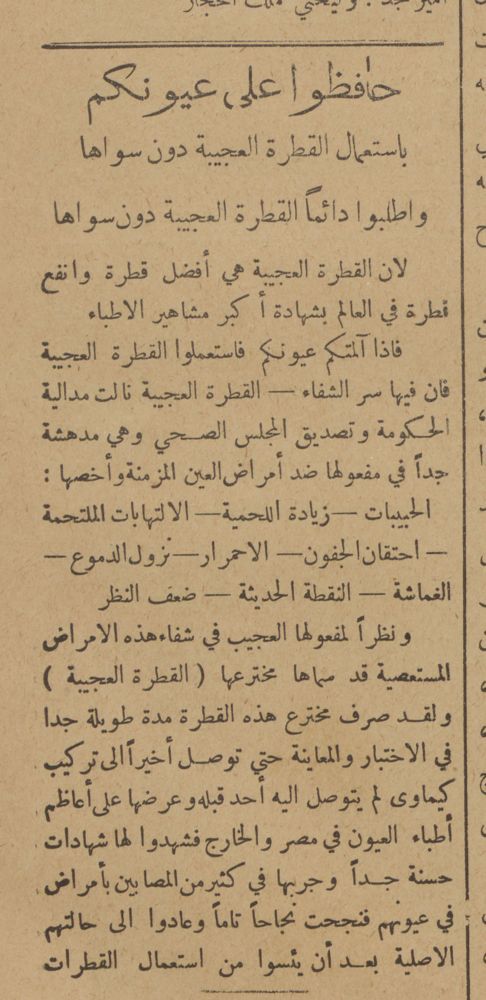
al-Qatra al-Agiba eye drops ad, al-Kashkul 1925
The headline is an instruction about the reader's own eyes, and the next line narrows it to one product and no other.
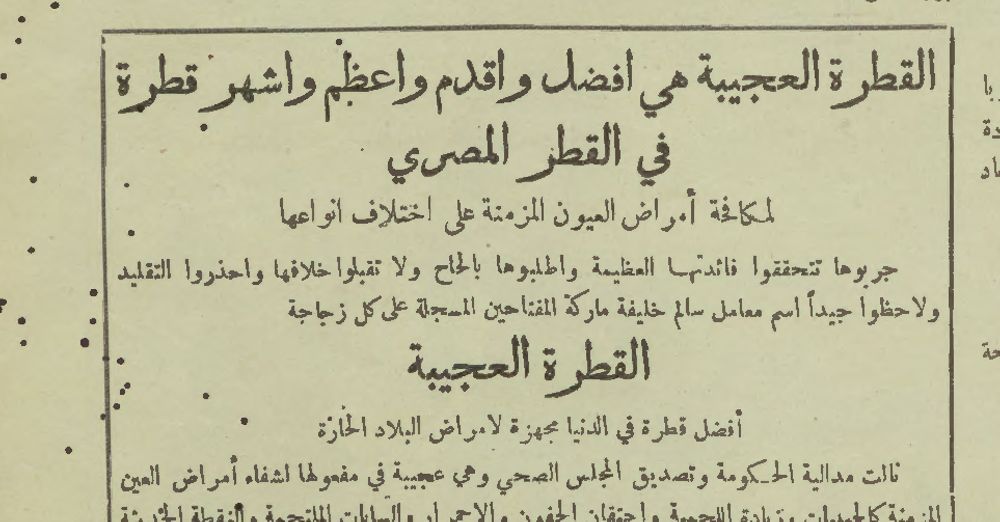
al-Qatra al-Agiba eye drops ad, al-Musawwar 1925
The drops are pitched as made for the diseases of hot countries, which speaks straight to readers living with Egypt's common eye complaints.
If this library is useful, leave an email
We send new patterns, ads, and notes when we add them. Name and phone are optional.
You are on the list
We will write when we add more library material.