
Joy
Ads and videos written to this emotion: 128. 89 make the Say move, 9 make the Avoid mistake.
What it is
A sudden rush of delight that makes you feel connected to something bigger. It hits hard and doesn't last, unlike happiness. It is usually shared with people close to you, and often comes when something good arrives sooner or better than hoped.
Where it shows up
Eid mornings, weddings, a homecoming, a child's first taste of something new.
Say
Let viewers know whose moment it is while the joy is rising: show the brand early, bring it back in short touches inside the scene and say the name once. Put the product where it would really be: the meal on the table, the phone that makes the call. It need not cause the joy or fill the frame.
Ads rated warmer, more exciting and more cheerful went with better brand attitudes, most of all for products bought for pleasure (Pham and colleagues 2013, 1,576 viewers and 1,070 TV ads in Belgium). Limit: one viewing in a test room, and joy could not be separated from warmth or excitement.
Brands placed in the centre of the screen made viewers skip more, and splitting the same brand time into short pulses cut skipping (Teixeira and colleagues 2010, 31 TV ads and nearly 2,000 viewers, with eye tracking). Limit: skipping in a test setting, not sales, and the ads were not chosen for joy.
Avoid
Nameless joy: a feel-good film where the brand appears only on the end card. People enjoy it, but joy they feel before they know the brand did not raise their wish to buy. The opposite mistake costs too: the product pushed to the centre of every shot interrupts the moment, and people skip the ad more and share it less.
Smiles after the brand first appeared went with higher purchase intent; smiles before it did not, and past a moderate level more entertainment lowered intent (Teixeira and colleagues 2014, 178 viewers and 82 TV ads, smiles tracked by webcam). Limit: drinks and sweets only, one viewing and stated intent rather than sales; two of the authors co-founded the face-tracking firm whose system was used.
Sources
- Pham, Geuens and De Pelsmacker (2013). International Journal of Research in Marketing 30(4).
- Teixeira, Wedel and Pieters (2010). Marketing Science 29(5).
- Teixeira, Picard and el Kaliouby (2014). Marketing Science 33(6).
Doing it right
Ads that make the Say move.
Albaik: one link turns a single order into a group order
The line One order, and the joy is for everyone sits over friends reaching into one shared spread on match night, with the Albaik group-order screen showing the four steps inside the scene.

Salvation Army "Keep her on the job" poster
The soldier's delighted cheer over a doughnut names its source, the Salvation Army lassie, inside the scene itself, so viewers know whose moment it is while the delight rises.
Albaik: One group order, everyone picks their own
Four friends' hands reach into one phone on match night, with a ball, goal net and scoreboard doodle around them, so the Albaik app sits inside the shared moment under 'the joy is for everyone'.

THE CHAP BOOK tops the sheet and every tumbling pierrot is lost in one of its little books, so the delight is plainly the magazine's own.
Al Rajhi Bank: share your moments with the travel eSIM
A man in a balloon basket raises his phone to film a sky of balloons, so the eSIM sits where it works, inside the moment, named in the line beside it.

The joy of a family vacation is shown with the brand inside it: children sail toy boats whose hulls are bars stamped IVORY, so the soap floats in the scene instead of interrupting it.

16 mm home film rental ad, al-Kawakib 1953
It names whose evenings these are, children's birthdays, private parties, family nights, puts the film show at home with Mickey Mouse spilling from the reel, and gives one call: 79948.
Ayer's Sarsaparilla health and sunny hours advertisement
The headline puts the brand over the scene, 'AYER'S SARSAPARILLA Gives HEALTH and SUNNY HOURS', so a mother lifting her child high reads as the brand's moment from the first glance.
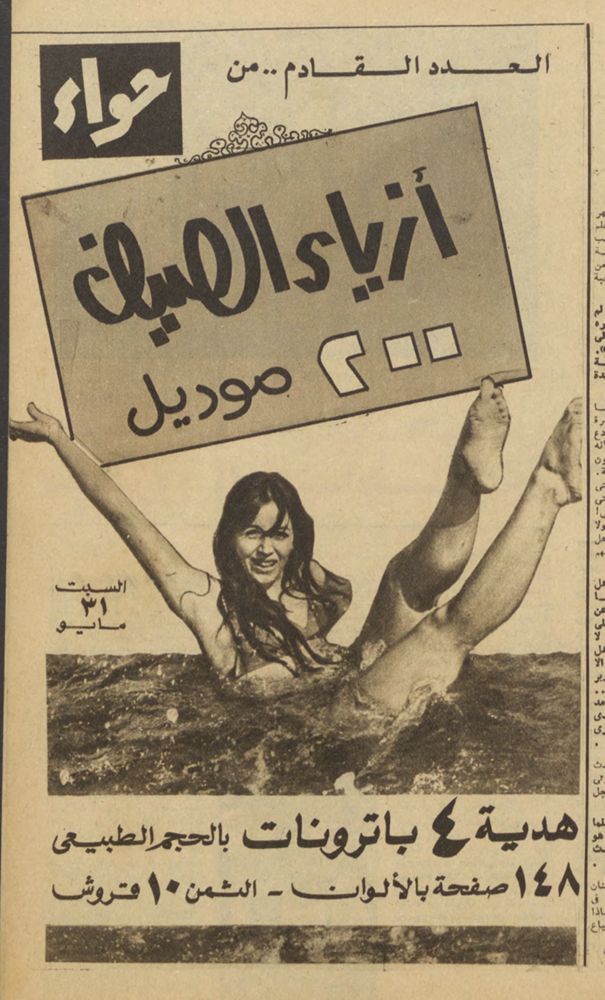
Hawaa magazine summer fashion issue ad, al-Kawakib 1969
A laughing woman splashing in the sea holds up the sign reading Summer Fashions: 200 designs, so the issue sits inside the moment of delight rather than waiting on an end card.
Warner's Safe Yeast advertisement with a grandmother dialogue
The child holding the tin to her sewing grandmother's nose makes the delight the family's own, and Warner's Safe Yeast is named and sits in her hand, right where the pleasure happens.

West End wristwatch ad, al-Kawakib 1962
The headline puns on the word for hours and watches, so West End is named inside the joy of meeting while the woman rests smiling against the man, and the watch sits below.

Kesma perfumes and cosmetics ad, al-Kawakib 1960
A woman tying ribbons beside a Christmas tree sits behind the Kesma range laid out as a gift set, so the brand and products are where they would really be in the holiday scene.

إعلان ڤودافون صيف ٢٠٢٤ - فرحة الصيف
Selfie-style panels of sand, pool, boat and beach dinner put the phone inside each summer, and the offer is the shared joy itself: send a song by name and both people win internet.

مع خدمة الاستلام من الفرع من جرير الحلو يكمل #مع_جرير_الحلو_يكمل
The girls' delight peaks inside a Jarir branch with the PS5 box in their hands and the logo on screen throughout, so the joy is tied to the store where the pickup really happens.

The family's delight rises at the table with the Afia logo in the corner throughout and the food where the oil really works, so the joy is clearly the brand's.

AD: "Super Jus" Old Commercial - Super Jus Juice Advertisement - Lebanon
The jingle repeats Super Jus from the start while each summer scene, a coast road, a swim, a garden, has a carton and straw in hand, so the brand sits inside the fun.

اعلان بسكويت ابو ولد اليمني 1985
The jingle sings Abu Walad before the goal, after the goal and on the pitch, so the name returns inside the boy's rising game while the box with his face stays in shot.

She names Yas Acres The Dahlias in her first line and the family's fun happens at and around the house, so the joy is the brand's from the start without crowding the scenes.
Doing it wrong
Ads that make the Avoid mistake.
No ad in the library does this yet.
If this library is useful, leave an email
We send new patterns, ads, and notes when we add them. Name and phone are optional.
You are on the list
We will write when we add more library material.