
Compassion
Ads and videos written to this emotion: 33. 17 make the Say move, 6 make the Avoid mistake.
What it is
Facing someone's suffering as an equal and offering kindness from beside them, not above them. It includes wanting to help, and its near neighbor is pity: the same concern felt from a distance, with the other person seen as lesser.
Where it shows up
Charity and relief appeals, health campaigns, zakat and Ramadan giving, a brand helping in a crisis.
Say
Show the need honestly, then the way forward: the person as someone with a life and plans, and exactly what the reader's help does and what changes after it (the water point, the school term, the course of treatment). For a brand, keep the cause and the people more visible than the logo, and say how much of each purchase goes to the cause.
Describing one concrete thing a charity does, clean water for villages in West Africa, instead of its work in general, raised real donations by over 80%, from $0.48 to $0.88 out of a $2 fee (Cryder and colleagues 2013, 119 adults in a US city; a second test with 94 more found the same). Limit: small sums and US donors.
In two UK experiments, an appeal showing people in context and with a voice (in one, a child in class holding a "future doctor" sign) did no worse on how many gave or how much than one showing a lone suffering child, and the pity appeal left people feeling less able to do anything about poverty (Beswick and colleagues 2019, a student lab test and a nationally representative survey). Limit: the chapter gives no sample sizes; UK donors, African beneficiaries.
Avoid
Pity: suffering staged to squeeze out a gift, people shown only as helpless, the reader cast as their rescuer. A sad face can lift giving in the moment, but dignified appeals have raised as much, and pity leaves people feeling nothing can change.
A sad face does pay in the short run: 77% of people shown a charity flyer with a sad child gave part of their $10 fee, against 52% when the same child looked happy or neutral (Small and Verrochi 2009, 151 US students and staff). Limit: mild sadness on a healthy child; those who gave did not give more, and the authors warn that intense misery may leave viewers feeling helpless.
Sources
- Cryder, Loewenstein and Scheines (2013). Organizational Behavior and Human Decision Processes 120(1).
- Beswick, Dasandi, Hudson and vanHeerde-Hudson (2019). Chapter 10 in an edited volume, Manchester University Press.
- Small and Verrochi (2009). Journal of Marketing Research 46(6).
Doing it right
Ads that make the Say move.
Ensan: A cared-for orphan's journey, ending at his wedding
A childhood photo held against the same man's real wedding shows the orphan Ensan cared for as a person with his own life, now starting a family, not a helpless recipient.

Will You Help the Women of France? Save Wheat poster
It shows the French women pulling the plough themselves to feed their children and the men in the trenches, people working, not waiting, and gives the comfortable reader one act at home: save wheat.

al-Muwasat Islamic Society hospital lottery ad, al-Musawwar 1932
It moves from the sick poor man near death to what the ticket does, saves his life and protects his weak children, then lists post offices, banks, shops and hotels to buy it today.
'Down but never out' Salvation Army Home Service Fund poster, 1919
'A man may be down but he's never out' treats the people helped as able to rise, not as lost causes, and dates the Home Service Fund week: May 19 to 26.

Islamic Muwasat Society hospital lottery ad, al-Musawwar 1932
After 'remember' brings up the sick poor man with no one to treat him, the third line names exactly what help does: a ticket in the lottery set aside for building the hospital.

United War Work Campaign poster: the "Y" and 2000 homes
One orange-lit hut in a snowy forest, with soldiers walking out of the dark to its door, shows exactly what a gift keeps open, and More than 2000 multiplies it.

Muwasat Islamic Society hospital lottery ad, al-Musawwar 1932
The untreated sick man is followed by a small, exact way to help: a sixth of a ticket for 10 piastres that builds the hospital, and a numbered list of where to buy it.

"Give clothing for war relief" poster
'What can you spare that they can wear?' ties the reader's surplus clothes to two ragged boys, one barefoot, and the red April 1 to 30 panel turns that into one dated act.

Muwasat Islamic Society hospital lottery ad, al-Musawwar 1932
It pictures the sick poor man as death closes in, then says what a ticket changes: it builds the charity hospital that saves him and shields his children.
Jameel Motorsport: Orphans' career dreams walk out as mascots
Orphans walk out in costumes of the careers they dream of, one astronaut hand in hand with the home captain, so they appear as children with plans, not as objects of pity.
Oreo: cookie pack becomes a pet house for shelter animals
The shelter pet introduces itself by name in its own voice on a pack shaped as its house, and the copy ends in one act: scan to meet adoptable pets from two named rescues.

Farm Frites Ad Ramadan 2015 - فارم فريتس تدعم جمعية ويانا لاطفال ذوى الاحتياجات الخاصة
Children with disabilities appear at a real fun day, not as helpless cases, and the act is exact: each Facebook badge means EGP 1 from Farm Frites to Wayana, up to EGP 100,000.

شبر ونص - انغام ومحمود العسيلي \
The song casts the child as tougher than adults and the one who eases their worries, shows happy children instead of illness, then lists exact ways to give, from any bank to 19731.

It shows the family as people with an ordinary evening, not as helpless cases, then names exactly what the gift funds: a monthly hemodialysis program.

مبارك عليكم شهر الخير - Wataniya Telecom TVC 2 - Ramadan 2013
It asks for presence, not only money: no description matches the viewer's own eyes, so it names small gifts, a thank you, a hug, an initiative, and the Draw a Smile route.

Farm Frites Ad Ramadan 2015 - فارم فريتس تدعم جمعية ويانا لاطفال ذوى الاحتياجات الخاصة
The footage shows Wayana's children on an outing, a girl making pizza, as people with lives, and each changed profile picture has a stated value: 1 pound to Wayana, up to 100,000.
Doing it wrong
Ads that make the Avoid mistake.
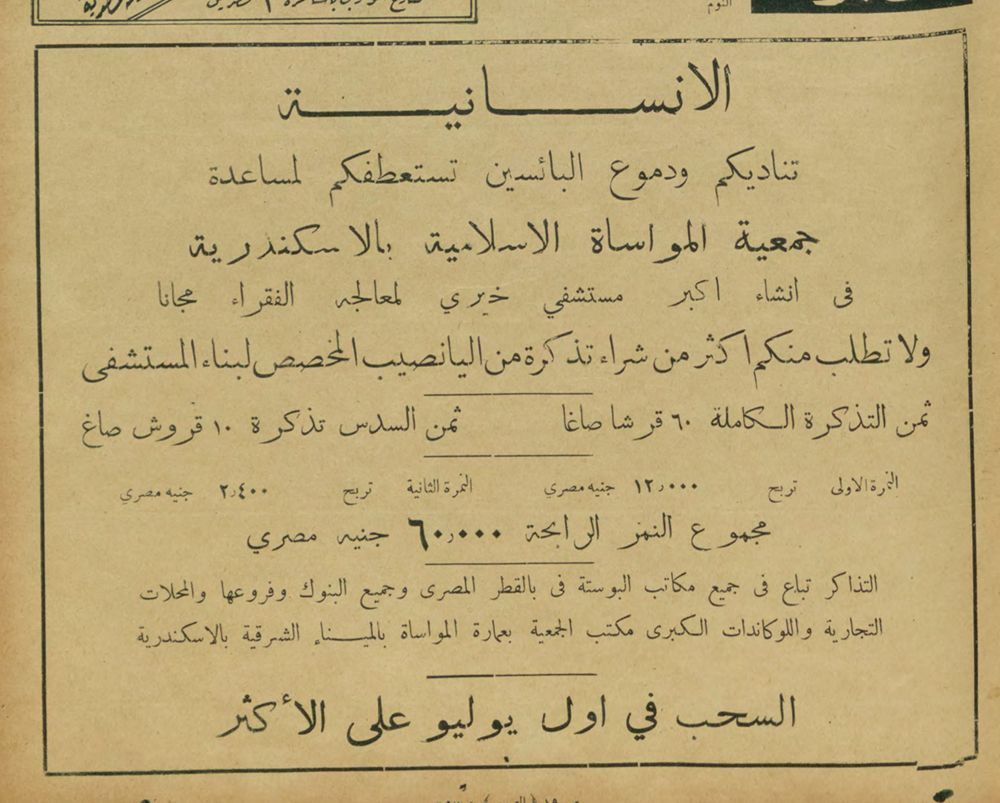
Islamic Muwasat Society hospital lottery ad, al-Musawwar 1932
Humanity calls on you and the tears of the wretched plead with you: the poor appear only as weeping and the reader as their rescuer, even though a free hospital for the poor is named.

Save food and defeat frightfulness poster with Whittier quote
Mother, nurse, old man and child are bound in ropes and reach for the word America, shown only as helpless with the reader cast as rescuer, while the ask, save food, gives no rule.

al-Muwasat Islamic Society hospital lottery ad, al-Musawwar 1932
The tears of the desperate call on the reader before any number appears, casting the poor as pleading and the reader as rescuer, then the ask shrinks to no more than one ticket.

A woman clutching her wrap speaks GIVE OR WE PERISH, so she appears only as helpless, the reader is cast as her rescuer, and nothing says what a gift does for her.

"Serbia" humanitarian relief poster
One word, SERBIA, over a weeping child and a mother with eyes shut shows a country only through its suffering, with no act for the viewer and nothing on what help would change.

Liberty Bonds poster: "Must Children Die and Mothers Plead in Vain?"
Shows the mother only as a helpless pleader, children clinging to her skirt, and casts the viewer as the rescuer whose bond decides whether 'children die'.
Guilt heavier than the lapse
If this library is useful, leave an email
We send new patterns, ads, and notes when we add them. Name and phone are optional.
You are on the list
We will write when we add more library material.