
Define
One line that can be replayed across executions so the campaign is a family, not a one-off.
Mechanism
Repeatable frame. Each ad is a verse. The line is the chorus. Recognition compounds because the structure is stable.
Verdict
We will run more than one execution and need them to add up in memory.
Don't
We have one shot. A series mechanism with a single ad is just a headline.
Copy skeleton
[THE LINE: 2 TO 5 WORDS, SAME WORDS, SAME PLACE, EVERY EXECUTION]
[THE FIXED FRAME: LOGO, LAYOUT, TYPE, CHARACTER OR COLOUR THAT NEVER CHANGES]
[VERSE N: THE ONE THING THAT CHANGES (MARKET / PRODUCT / OCCASION / FACE)]
[THIS VERSE'S PROOF OR OFFER: [A DETAIL THAT ONLY FITS VERSE N]]
[CLOSE: THE LINE AGAIN, OR THE HASHTAG THAT CARRIES IT]
[SERIES PLAN: VERSE 1 [ ] · VERSE 2 [ ] · VERSE 3 [ ] · RUNS FOR [WEEKS]]
Gulf note
In the Gulf a series line often has to work in Saudi dialect and in English, so test that it survives the switch before the first post goes out. Hang the verses on a calendar the audience already keeps: Ramadan nights, Eid, Founding Day, National Day, back to school, with the line unchanged and only the occasion swapped. On Snapchat, TikTok and Instagram, put the line in the same corner of every frame and say it aloud in the opening seconds, because recognition there happens at scroll speed. For brands serving expatriate communities, keep the line and change the face, the language and the destination.
Rights-cleared examples

"Concerning Three Presidents" testimonial ad
Three separate consumer letters are welded into one page by a single organising conceit, which turns ordinary testimonials into a feature the reader will actually read through.

7-Up "You like it, it likes you" ad, Ladies' Home Journal, 1948
The ad solves a category problem with one image: a soft drink is usually filed as a children's purchase, so the family is literally stacked on the bottle to widen the buyer's idea of who it is for.

al-Kawakib al-Mawsim annual issue ad, al-Kawakib 1958
This is the countdown version of the teaser: the same planet, the same six star faces, the same promise of colour photos of screen beauties from East and West, but the bottom strip now names the day, next Tuesday 18 November.

Aramco oil drilling series ad, al-Musawwar 1956
Nothing is for sale: a tall offshore rig towers over a work barge, and one plain paragraph explains how geologists locate oil and why test wells are drilled, ending with the count of 141 producing wells in Saudi Arabia by the end of 1954.

Arrow Collar "Marcy" Arrow Collar Man ad, 1920
The product occupies maybe a tenth of the image and the face occupies the rest, which is the whole trick - the collar is sold as a consequence of the man, not as a feature set.

Booth's broiled sardines tin label
The strip sells an occasion, not a fish: the sealed tin sits at the left, a foaming glass of beer and a plate of sardines on greens at the right, and BOOTH'S Broiled SARDINES fills the space between, so the eye reads pack, name and moment in one sweep.
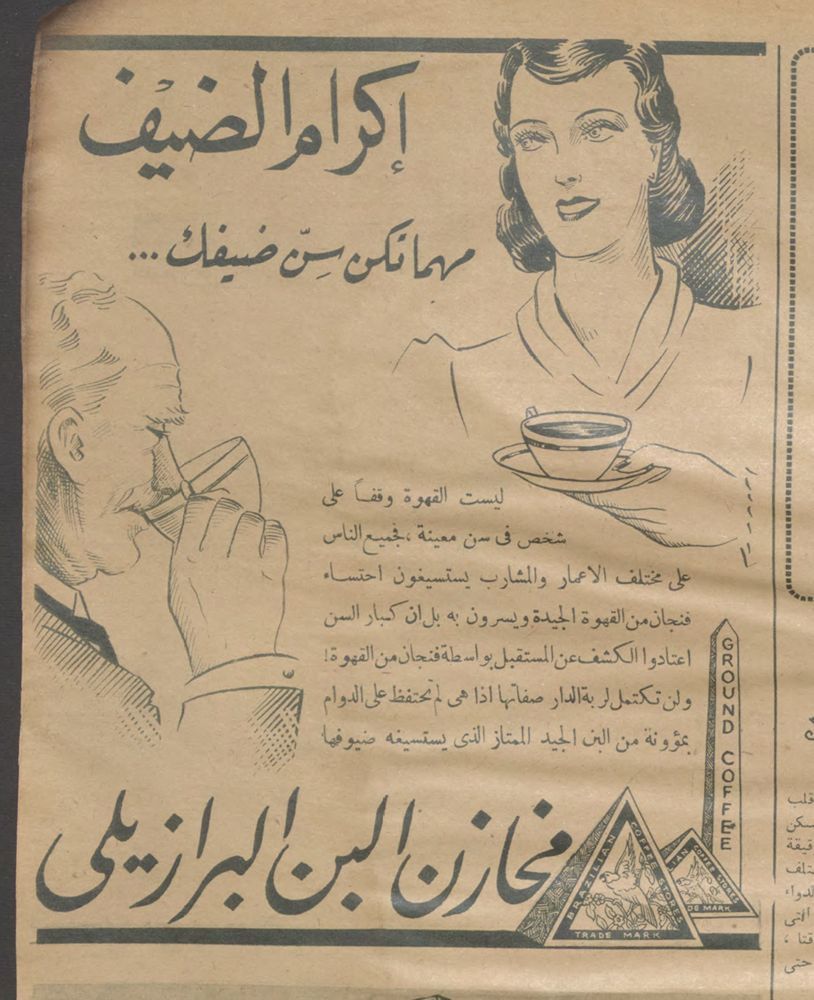
Brazilian Coffee Stores coffee ad, al-Musawwar 1941
The same headline as the week before returns, honouring the guest, but with a new twist: whatever the guest's age.

Breck "Beautiful Hair" Breck Girl ad, Photoplay, 1955
The illustration, not the copy, is the product claim: a painted rather than photographed portrait lets the hair be idealised past what any photograph could show while still reading as a real woman, which is why the campaign could run for decades on the same device.

Breck Girl ad with Kim Basinger and her mother
The campaign's engine is the portrait-series device: by calling each ad one of the latest in Breck's series of pastel portraits of American women, the brand turns its advertising into something with continuity that readers collect and recognise, so each individual ad inherits the credibility of every one before it.

Breck Girl ad with Kim Basinger, art by Ralph William Williams
This is the sequel ad, and the mechanism is the payoff: the same brand that announced the contest winner now shows what happened to her, which turns an advertising promise into a documented outcome and makes the contest itself worth entering.

Campbell's Tomato Soup "Gift of the Golden Summer" ad, 1948
The whole page argues freshness by substitution: the reader never sees the manufacturing, only the raw crop, so the canned product inherits the credibility of the basket.

Cicurel department store ad, al-Musawwar 1932
The page carries only three things: the store's name in huge hand lettering, the words great opportunity, and a start date.
If this library is useful, leave an email
We send new patterns, ads, and notes when we add them. Name and phone are optional.
You are on the list
We will write when we add more library material.