
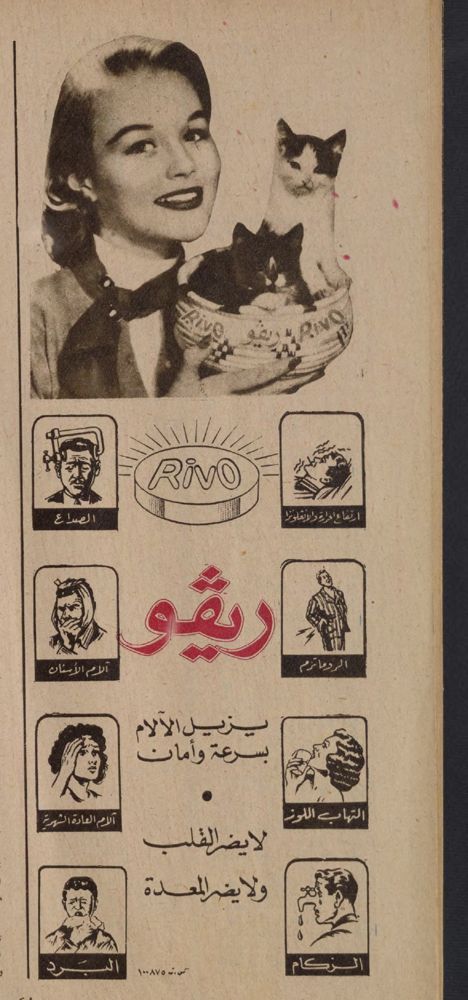
Rivo painkiller tablets ad, al-Kawakib 1962
American University in Cairo, Rare Books and Special Collections Library. al-Kawakib. RBSCL believes this item is in the public domain.
The pattern
This still is filed under Problem-agitate-solve.
Define
Name the problem, make the cost of leaving it felt, then present the way out as relief.
Mechanism
Tension then release. The offer is not an interruption. It is the only door once the cost of staying is clear.
Verdict
The problem is known but not yet urgent
Why it works
Eight small drawn panels surround the tablet, each one labelled with a single pain: headache, toothache, fever and flu, rheumatism, period pain, sore throat, cold, runny nose. A reader scanning the grid finds their own complaint in a second and sees the same pill at the centre of every one. The closing line that it harms neither the heart nor the stomach answers the fear of strong painkillers before the reader raises it.
The big idea
Each of eight everyday pains gets its own labelled picture around one tablet, and all of them end in the same promise: Rivo removes pain quickly and safely.
The offer
Rivo tablets for headache, fever and flu, toothache, rheumatism, period pain, tonsillitis, colds and catarrh.
The proof
Only a safety claim: it does not harm the heart and does not harm the stomach.
Lines from the ad
ريڤو يزيل الآلام بسرعة وأمانRivo removes pain quickly and safely
لايضر القلب ولايضر المعدةIt does not harm the heart and does not harm the stomach
Steal this when
When one product fixes many small everyday complaints, give each complaint its own labelled picture around the product so every reader finds theirs.
The emotion
Written to Relief. It makes the Avoid mistake.
Every one of the eight labelled panels ends in the same line, Rivo removes pain quickly and safely, repeated as a promise with no sufferer's words or shown result to check it against.
If this library is useful, leave an email
We send new patterns, ads, and notes when we add them. Name and phone are optional.
You are on the list
We will write when we add more library material.