
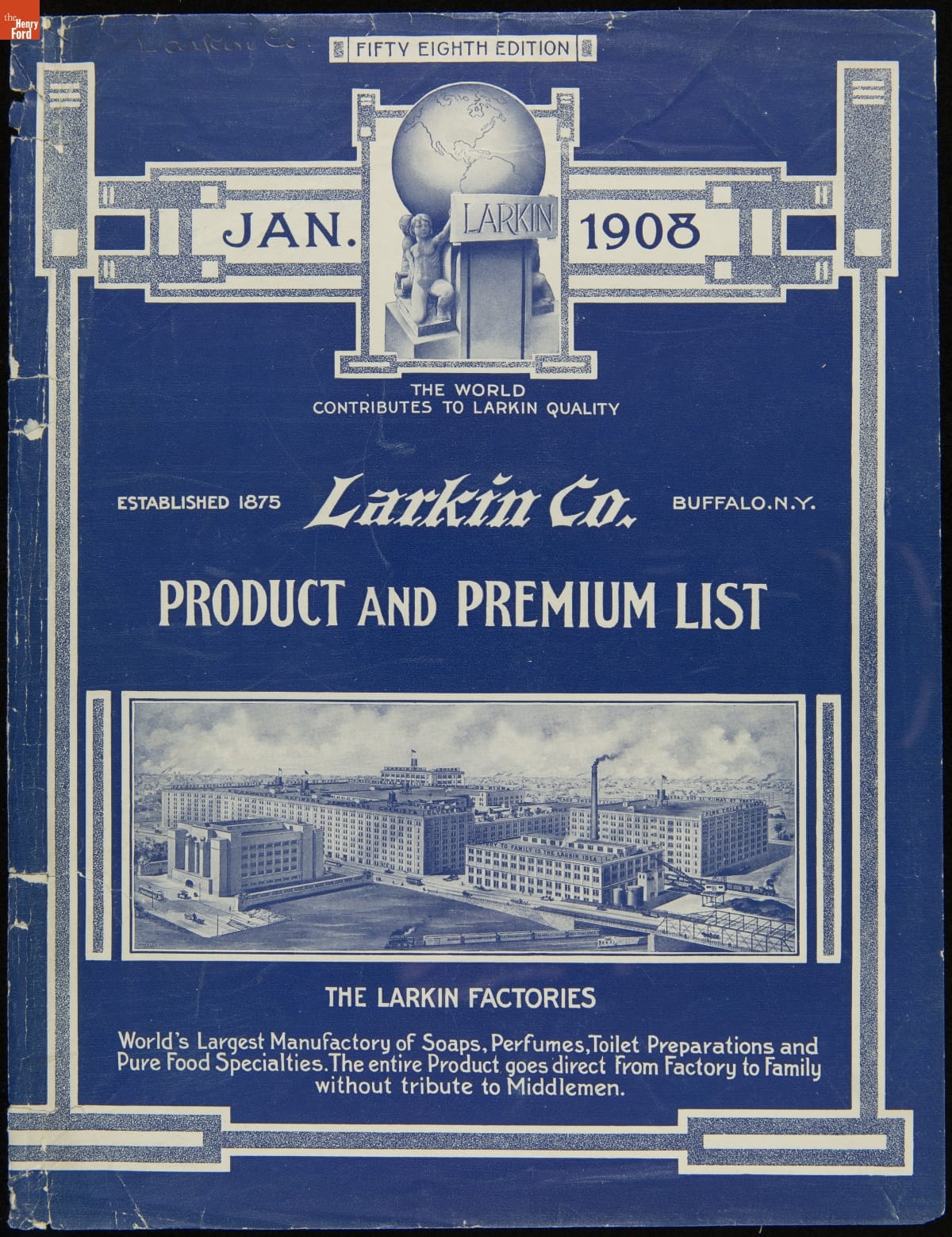
Larkin Company 'Product and Premium List,' January 1908 (58th Edition) (cover)
The pattern
This still is filed under Mail-order catalog.
Define
A catalog that is the store: browse, choose, order, without a clerk and often without a website.
Mechanism
Assortment as argument. Density, numbering, and an order path do the closing. The book is the funnel.
Verdict
We have a range, remote buyers, and a way to take the order on the same object.
Why it works
The cover is doing positioning rather than selling: globe, edition number and factory panorama all argue scale, and scale is the thing that makes a stranger trust a mail order from a distant city. Putting Premium next to Product in the title tells the reader half the book is reward catalogue, which is the reason it stays in the house instead of the stove. The closing line states the business model as a grievance the reader already holds - without tribute to Middlemen - so the price story arrives as fairness rather than as discount. Reversing everything out of one solid ink makes a single-colour job look like a bound volume.
Steal this when
Use this when your real advantage is structural rather than product-level: put the mechanism on the cover in one plain sentence so every reader files you in a category of one. The edition number is worth stealing whenever longevity and repeat use are your strongest proof.