
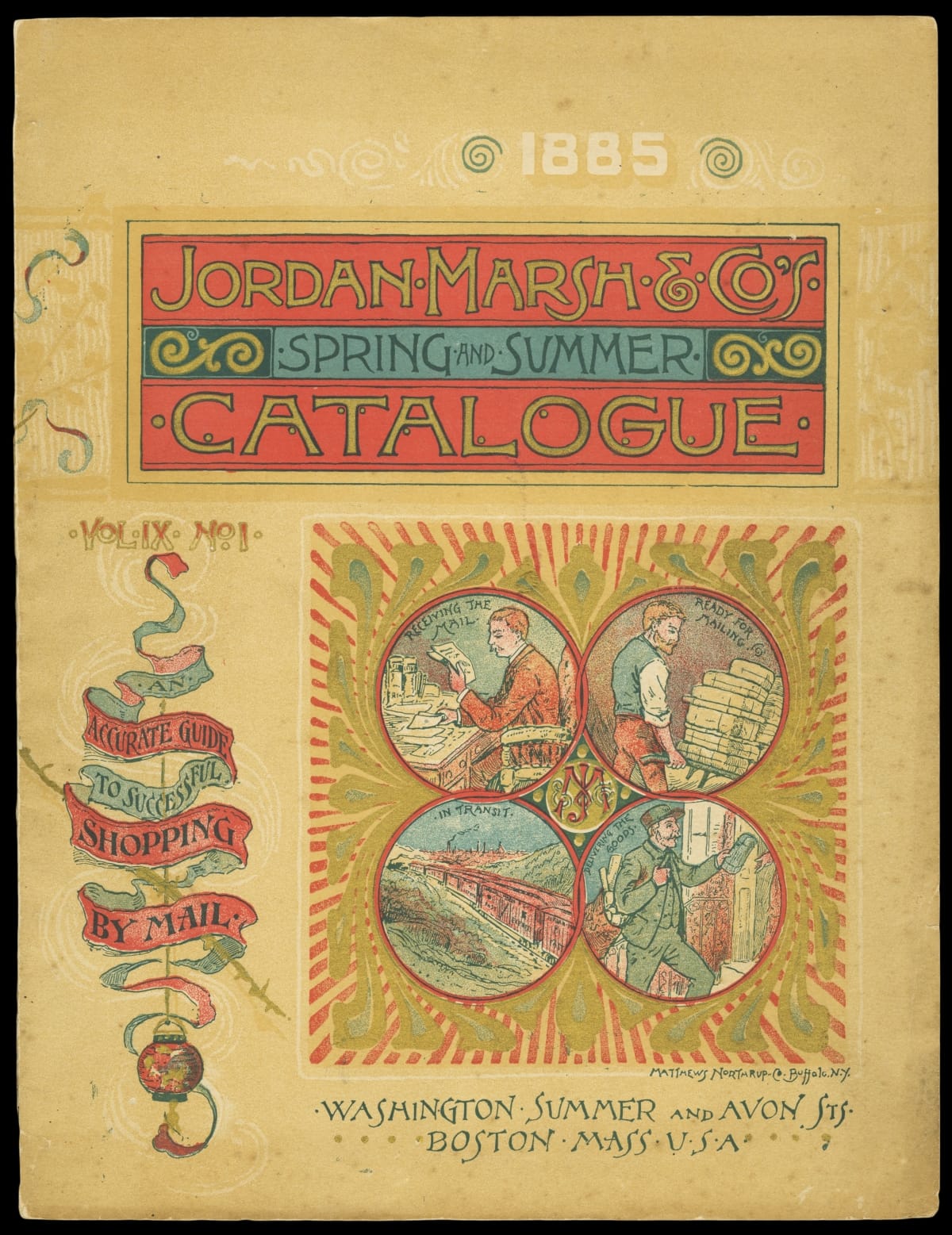
Jordan Marsh & Co. Spring and Summer Mail-Order Catalog, 1885 (cover)
The pattern
This still is filed under Mail-order catalog.
Define
A catalog that is the store: browse, choose, order, without a clerk and often without a website.
Mechanism
Assortment as argument. Density, numbering, and an order path do the closing. The book is the funnel.
Verdict
We have a range, remote buyers, and a way to take the order on the same object.
Why it works
The cover answers the only question a first-time mail-order buyer actually has, which is not what do you sell but what happens after I send the money, and it answers it in pictures because a picture of a process is read faster than a paragraph promising one. The four vignettes are sequenced as a narrative loop that ends at the customer's own front door, so the last thing the reader sees is herself receiving the goods, which is the closest thing 1885 had to a delivery-tracking screen. The ribbon banner does the positioning in five short phrases and calls the book a guide rather than a catalogue, which reframes a sales document as instruction and lowers the guard of someone who does not yet know how this works. Naming the volume and number is a quiet trust device, because nine years of issues implies a business that will still be there when the parcel is due.
Steal this when
Use this when you are asking people to transact in a way that is new or unfamiliar to them and the real objection is procedural anxiety rather than price or product. Showing the fulfilment chain end to end, finishing at the customer's door, is the move whenever distance or delay sits between payment and delivery.