
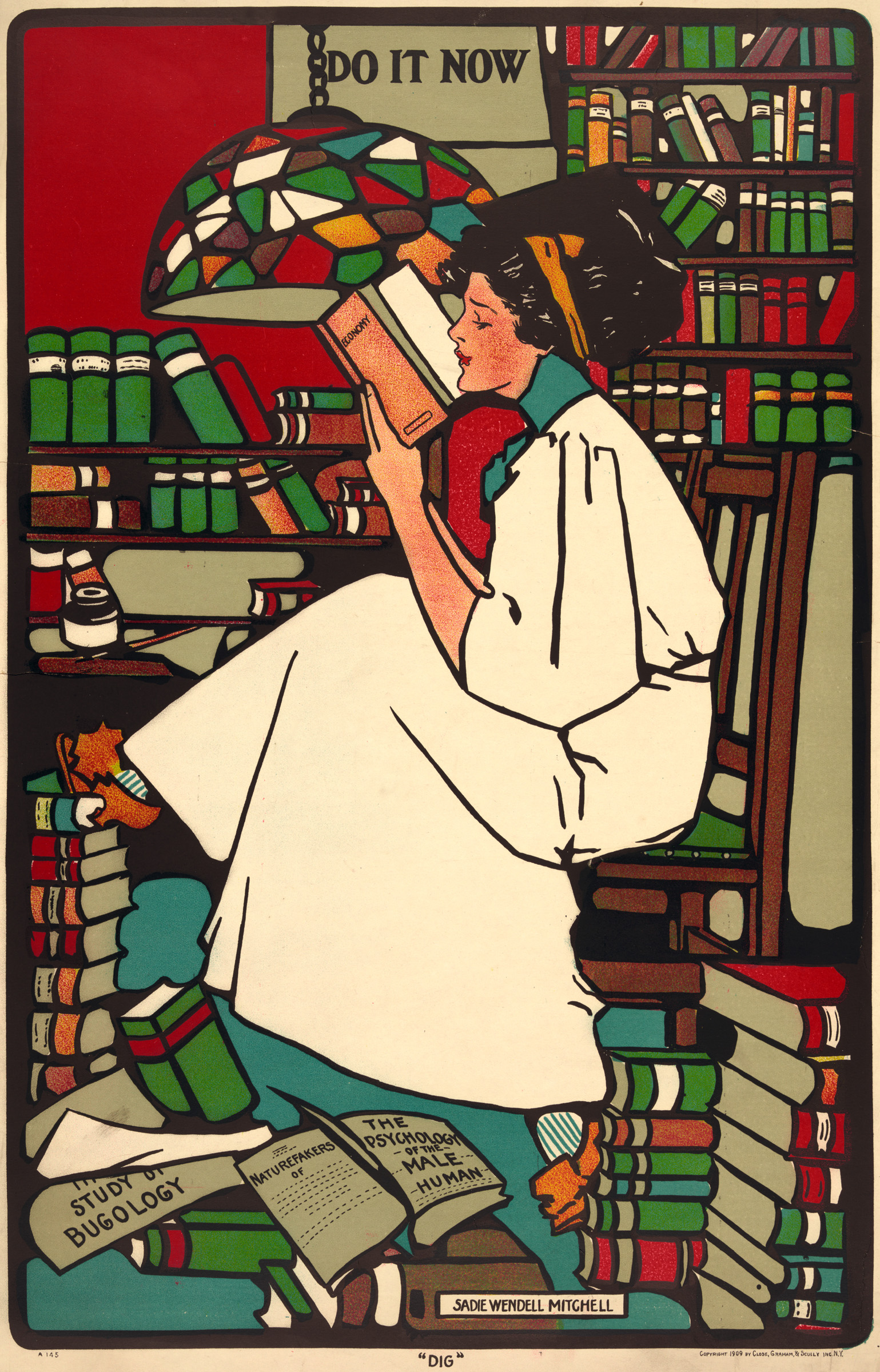
Sadie Wendell Mitchell, "Dig", 1909
The pattern
This still is filed under Image carries the claim.
Define
One image does the entire argument. Copy, if any, is a caption, not a second ad.
Mechanism
Pictorial claim. The picture is readable as a sentence. If we need a paragraph, we picked the wrong picture.
Verdict
The idea is visual and the surface is a poster, a feed, or a silent frame.
Why it works
The joke is buried in the props, not stated: the placard, the book she is reading and the three titles open on the floor are the punchline, so the piece rewards the second and third look and earns its place on a wall people see daily. Flat colour and a uniform heavy outline let an extremely busy scene stay readable - the eye sorts it by colour block rather than by depth. The white blouse is the only large uninterrupted field in the picture and it sits dead centre, which is what keeps the figure from being swallowed by the bookshelves. The title is demoted to a small caption outside the image, so the picture is the whole sale and the word only names it.
Steal this when
Copy this when the audience is in on the joke and you want them to find it themselves - put the message in labelled props inside the scene rather than in a headline. The flat-outline, one-big-empty-shape approach is the right call whenever a busy illustration still has to read from across a room.