
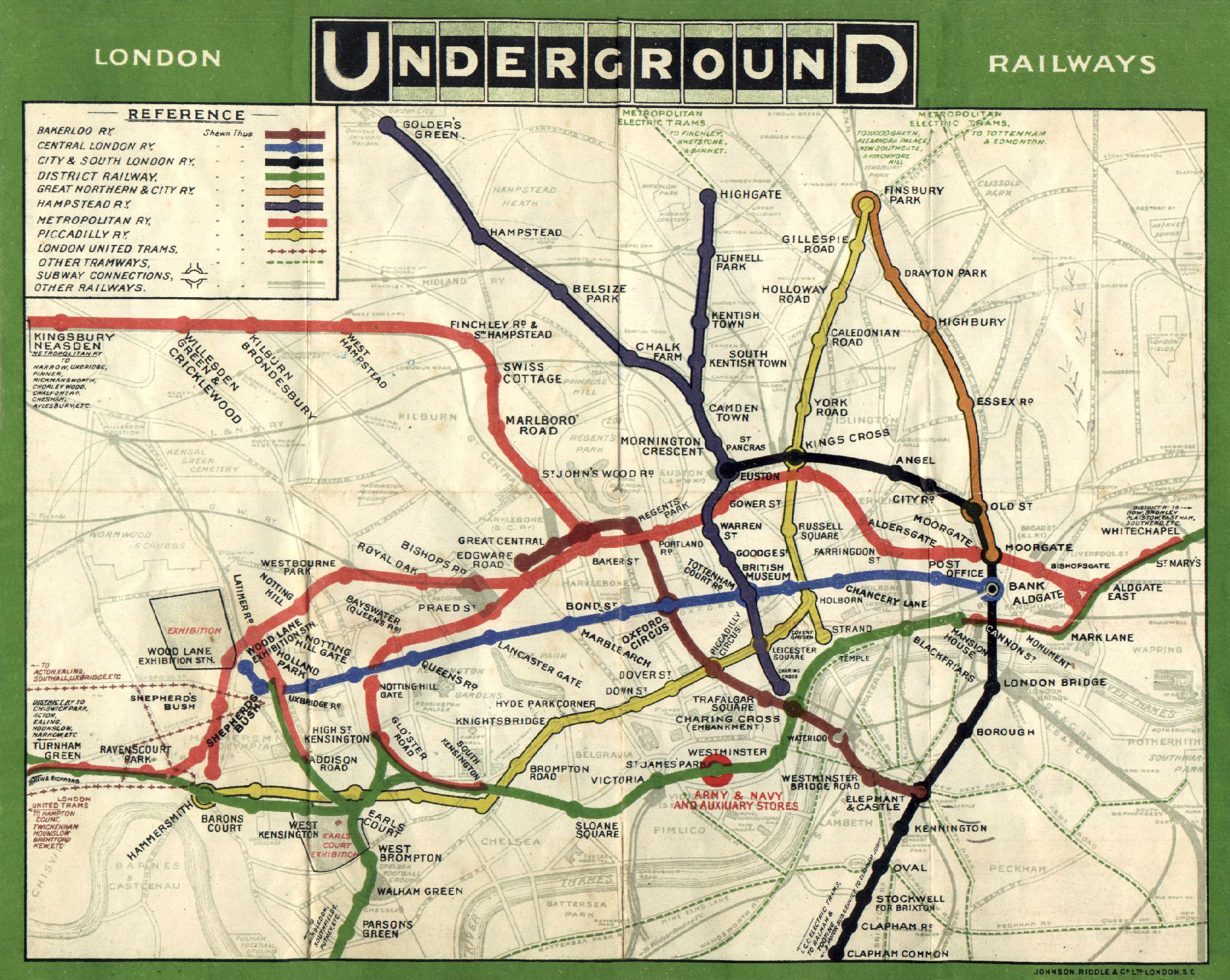
London Underground map, 1908 (first joint 'UNDERGROUND' network diagram)
The pattern
This still is filed under Data as proof.
Define
A chart, map, or count that is the argument, not an illustration next to the argument.
Mechanism
Sighted evidence. The reader is asked to believe their eyes: a bar, a share, a spread on a map.
Verdict
The claim is comparative or quantitative and the figure can be read without a caption doing the sell.
Why it works
The design problem here is commercial, not cartographic: eight rival firms needed to look like one service without any of them disappearing, so the solution puts a single wordmark on top and gives every operator its own colour underneath. Colour coding does the work that no amount of naming could, because a traveller can follow a line end to end without reading a word. Keeping the street base faint and the route lines fat is an early, explicit ranking of what matters, though the map still bends the lines to real geography, which is exactly the compromise Beck broke twenty-five years later. The chequerboard treatment of UNDERGROUND turns a generic common noun into a mark, the first step toward owning the category word.
Steal this when
Use this when several separate suppliers, business units or product lines have to be sold as one system while each keeps its own identity. Give the group a single mark at the top and give each member one unambiguous visual code below it.