
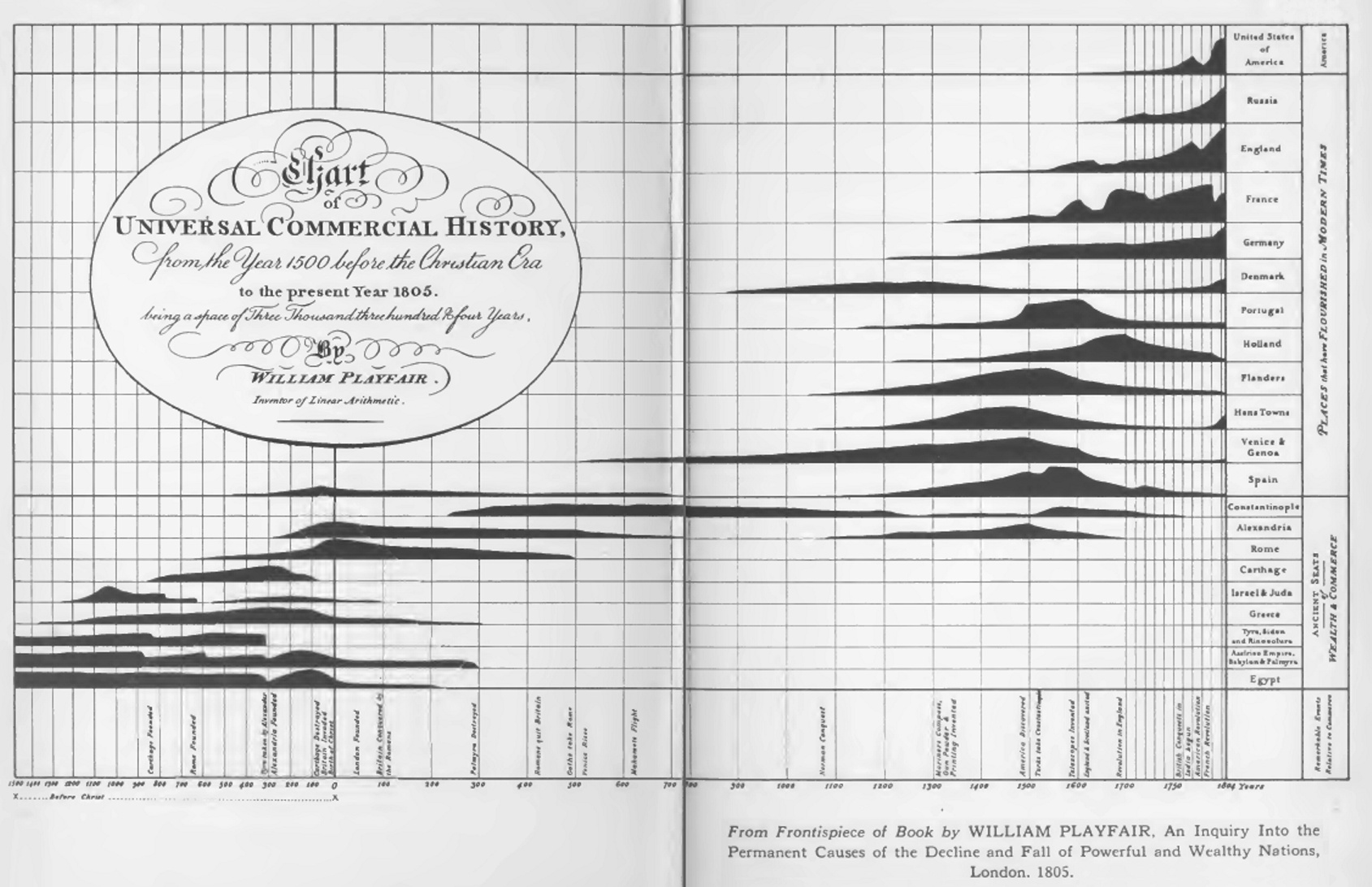
Chart of Universal Commercial History
The pattern
This still is filed under Data as proof.
Define
A chart, map, or count that is the argument, not an illustration next to the argument.
Mechanism
Sighted evidence. The reader is asked to believe their eyes: a bar, a share, a spread on a map.
Verdict
The claim is comparative or quantitative and the figure can be read without a caption doing the sell.
Why it works
Playfair names every band at the end of the band itself rather than in a key, so identification costs the reader nothing and the eye never leaves the mark. Filling each series as a solid silhouette converts an unmeasurable quantity into a shape that swells and thins, which makes the argument comparative rather than numeric. The right-hand bracket does editorial work before any row is read: ancient block below, modern block above, so the pattern of death and replacement lands as a single impression. The empty upper-left where no data exists is spent on the title instead of being padded with grid.
Steal this when
Use this when you need to show that something the audience treats as permanent is one instance of a repeating cycle. Put every comparable case on one shared timeline, label in place, group them with a bracket that carries your verdict, and spend the empty quadrant on the title.