
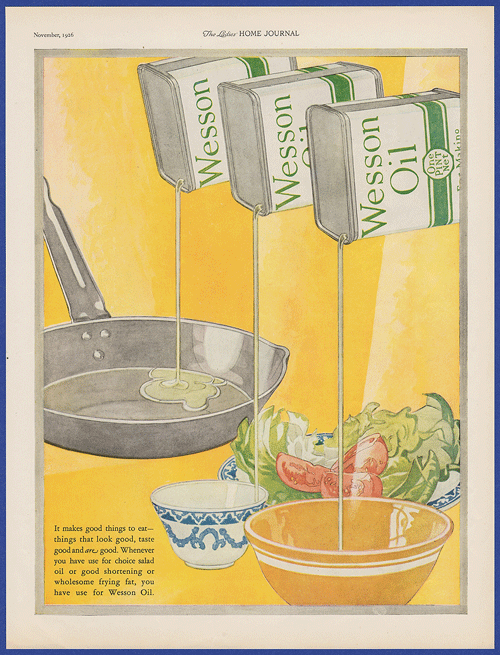
Wesson Oil 'It makes good things to eat' advertisement, Ladies' Home Journal, November 1926
The pattern
This still is filed under Headline · visual lockup.
Define
Headline and picture are one sentence. Remove either half and the claim disappears.
Mechanism
Lockup. The line names what the image will not. The image shows what the line cannot. They are not redundant.
Verdict
We have a picture that completes a short line: wit, contrast, or a second meaning.
Why it works
This is Calkins and Holden's 'styling the goods' method: the package is not photographed in a kitchen, it is redrawn as a flat decorative shape and hung in space, so the ad reads as design rather than as grocery. The three parallel pour-lines do the argument silently, turning a versatility claim into a diagram the reader grasps before reading a word. Withholding the headline entirely makes the picture carry the whole page and forces the small type block to be read as a caption, which is a low-pressure register for a repeat-purchase staple. The yellow flood ties the oil, the page and the appetite together and would have owned the spread in a magazine printed mostly in black.
Steal this when
Your product's selling point is that it replaces several separate products. Draw the one thing feeding the several uses at the same moment rather than listing the uses in copy.